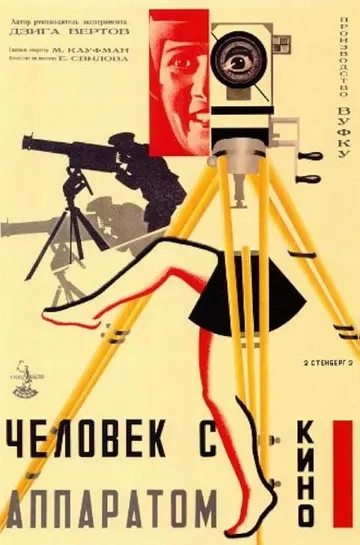
Dziga Vertov / 吉加·维尔托夫 · 1929
Man with a Movie Camera
Человек с киноаппаратом
Eye, lens, city, machine, and editing table connect through superimposition and accelerated intervals without submission to a stable human viewpoint. The camera enters movement between things, releasing perception from a centred subject toward matter’s dispersed state.
Film details
- Original title
- Человек с киноаппаратом
- Director
- Dziga Vertov / 吉加·维尔托夫
- Year
- 1929
- Region
- Soviet Union
Film analysis: how shots organize concepts
The camera enters intervals between things, releasing perception from a single human eye into a dispersed urban-material network.
- 01Viewpoint changes position
Cameraman, lens, transport, working bodies, and spectators look through one another via split screen, superimposition, and reflection.
The camera no longer represents a stable subject. - 02Intervals produce connections
Blinking eye, shutter, machine cycles, and editing-table rhythms are joined as movement across objects.
Any point can act upon any other through the interval. - 03Perception approaches matter
Slow motion, acceleration, reversal, and microscopic angles detach the city from ordinary human scale.
The perception-image approaches a decentered, gaseous state of matter.
Close-reading questions
- 01When eye, lens, shutters, machinery, and urban labour are superimposed, how does seeing shift from a human subjective position to a perceptual network composed of material movements?
- 02When waking, traffic, production, marriage, divorce, birth, and death are linked by speed and direction, how do intervals between shots construct a city-day without following a protagonist?
- 03When the camera sets itself up, the cameraman enters a beer glass, and the editor is filmed at work, how does the film turn its recording apparatus into a moving object of analysis at the same time?
Analysis and scene sources
Shots and scenes
Primary texts, scholarship, and locators
Theory coordinate: Cinema 1, Minnesota 1986, ch. 3, p. 40; ch. 5, p. 82
- 01Cinema 1: The Movement-Image
Standard Minnesota English translation and a principal citation edition in Anglophone scholarship.
Open the atlas source record →
This film in books and research
Deleuze and Cinema: The Film Concepts · Book case
Man with a Movie Camera
pp. 72–78
Film relation: The machine eye places the camera within world-flow and tests acentred perception.
Shot question: How does the camera become both perceiver and perceived object?
Viewing gateways and editions
No direct viewing link is listed; film search gateways are available above.