 01:09:40
Memory and temporal strata · SHOT EVIDENCE
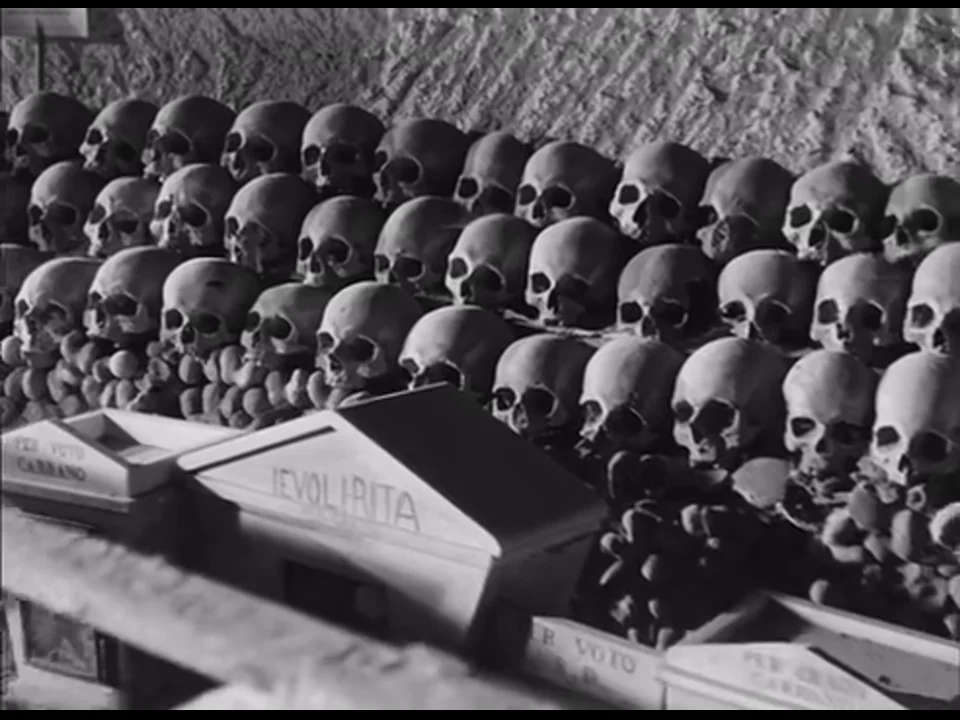
Anonymous skulls receive war dead and an unborn child
How does a cavern holding anonymous dead give visible place to personal memory and a future wish at once?
Film and viewing version
Journey to Italy · Viaggio in Italia · Roberto Rossellini / 罗伯托·罗西里尼 · 1954
Frame-checked against the single-part Bilibili repost stream BV1h5MVzfEdW: the page API reports 5,141 seconds, while the retrieved qn16 media runs 5,140.78 seconds at 492×360. Player v2 supplies no usable subtitle track; English dialogue sense was aligned by scene content with an English SDH subtitle file from the Criterion Blu-ray. Every timecode follows the Bilibili carrier.
Version boundary: The timecodes on this page apply only to the named viewing carrier. Restorations, differing leaders, or platform transcodes may shift them.
Passage and still timecodes
01:08:34 to 01:11:24
Passage bounds checked on the named carrier
The passage bounds and Bilibili still at 01:09:40 were checked separately on their named carriers. They remain distinct coordinates and do not establish identical timecodes for other versions.
Visible facts
- 01
Katherine and Natalia enter a dark cavern where skulls, long bones, devotional boxes, flowers, and candles line the walls.
- 02
The film cuts among rows of remains, the two women's bodies, and the altar deep inside; Katherine repeatedly stops to look.
Audible facts
- 01
Footsteps, low prayer, and cavern reverberation reduce the volume of ordinary conversation.
- 02
Natalia says that her brother died in Greece during the war and that she comes here to pray for him; she then voices her wish for a child.
Action relation
Arranging remains, lighting candles, and praying are concrete rites, yet they cannot return the war dead or guarantee a future child; Katherine chiefly bears the looking.
Temporal relation
Centuries-old anonymous dead, a brother lost in war, and a child not yet born are juxtaposed through one prayer rather than ordered chronologically.
Conceptual reading
The distinction between visible remains and Natalia's private speech must be preserved; they connect through space and audio-visual relations rather than becoming the same thing.
Concepts used in the judgement
- The seervoyant · SCENE SUPPORT
Facing a layer of death no personal action can repair, Katherine's looking becomes witness.
→ - Pure optical / sound situationopsigne / sonsigne · SCENE SUPPORT
Rows of remains, low prayer, and reverberation retain distinct densities while interrupting ordinary action together.
→
Primary and scholarly coordinates
- 01Cinema 2: The Time-Image
Minnesota 1989 translation: ch. 1, p. 2 (listed as The Lonely Woman [Viaggio in Italia]).
Brief primary-text mention: on this page Deleuze includes Katherine among female tourists struck by unfolding images and visual clichés; the fuller argument for the turn from agent to seer comes from the surrounding chapter. This site analyzes each scene window, audio-visual fact, and criterion shot by shot.
Terminological coordinates
- seervoyant
Action cannot absorb what is seen, so looking itself acquires structural force.
→ - pure optical and sound situationsituation optique et sonore pure
Remains and prayer exceed tourism and explanation, compelling the figures to remain.
→ - opsign / optical signopsigne
Rows of skulls act as opsigns establishing a layer of death no personal story can fully possess.
→ - sonsign / sound signsonsigne
Low prayer and cavern echo place a private wish within a collective sound field.
→
Chapter relations
Viewing and still sources
Direct scene · Complete single-part film on Bilibili; the page, anonymous Player API, media bytes, and full 5,140.78-second duration were verified. Submission label: repost.