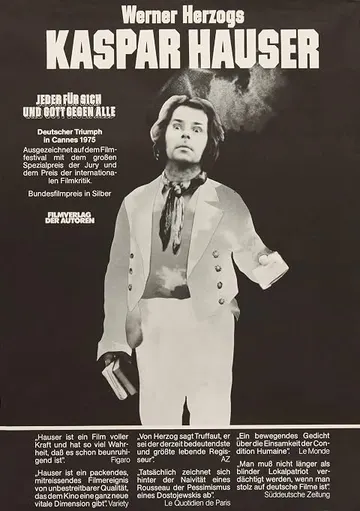
Werner Herzog / 沃纳·赫尔佐格 · 1974
The Enigma of Kaspar Hauser
Jeder für sich und Gott gegen alle
Writing, table manners, and logical puzzles try to insert Kaspar into social action, while his landscape visions open another passage in the image. Fields, mountains, and desert are not psychological illustrations; they split the small figure's local situation in two. Society can train his acts but cannot absorb his seeing.
Film details
- Original title
- Jeder für sich und Gott gegen alle
- Director
- Werner Herzog / 沃纳·赫尔佐格
- Year
- 1974
- Region
- West Germany
Film analysis: how shots organize concepts
Society can train Kaspar's acts but cannot assimilate his heterogeneous seeing to established knowledge; landscape visions split the local situation.
- 01Acts produce social identity
Kaspar learns to stand, eat, hold a pen, and write his name while each posture is corrected.
Sensory-motor training inserts the body into society while delimiting intelligible response. - 02The answer refuses the rule
A logician poses a village puzzle, and Kaspar answers outside its prescribed path of inference.
Social knowledge cannot contain his perception, shifting his position from agent toward seer. - 03Landscape opens a second layer
Visions of fields, mountains, and desert abruptly enter scenes of education and display.
The landscapes are not explanatory memories but a visual layer that social action cannot absorb.
Close-reading questions
- 01As Kaspar is taught to write his name, grip, mark, and repeated command insert his body into society; how does learned action produce identity and obedience together?
- 02Kaspar rewrites the logician's puzzle with his own answer: rule-bound reasoning → heterogeneous response → failed knowledge. Why can society not translate his perception into prescribed action?
- 03Fields, mountains, and desert visions interrupt daily instruction: local situation → landscape fissure → seer. Why are these images not psychological flashbacks?
Shots and scenes
Primary texts, scholarship, and locators
Theory coordinate: Cinema 1, Minnesota 1986, ch. 10, pp. 185–186
- 01Cinema 1: The Movement-Image
Standard Minnesota English translation and a principal citation edition in Anglophone scholarship.
Open the atlas source record →
Viewing gateways and editions
No direct viewing link is listed; film search gateways are available above.