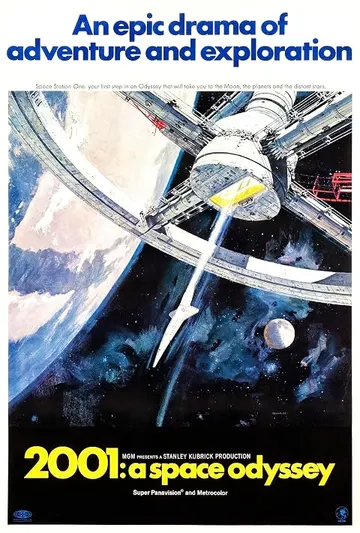
Stanley Kubrick / 斯坦利·库布里克 · 1968
2001: A Space Odyssey
2001: A Space Odyssey
Space becomes a topology of the brain; HAL and humans mirror one another across automatism, choice, and thought’s impotence.
Film details
- Original title
- 2001: A Space Odyssey
- Director
- Stanley Kubrick / 斯坦利·库布里克
- Year
- 1968
- Region
- United Kingdom / United States
Film analysis: how shots organize concepts
Tool, computer, and star gate progressively carry human action beyond its own scale until brain-like space no longer obeys an executable route.
- 01A tool compresses history
An ape recognizes a bone as a weapon; when it rises into the air, a match cut lands on an orbiting spacecraft.
A vast technical history folds into one continuity of movement, while the logic of the tool becomes the governing circuit of the human world. - 02Calculation captures perception
Through lenses, lip-reading, life data, and airlock control, HAL sees, interprets, and disposes of the astronauts at once.
The perception-action chain leaves the human body, turning the spacecraft into a closed cerebral circuit. - 03Route becomes the unthinkable
The star gate's colour, alien terrains, and white room cancel stable orientation; Bowman sees himself age successively within one space.
Action-space becomes a time-space thought cannot master in advance, forcing the spiritual automaton to confront its limit.
Close-reading questions
- 01Why does the match cut from monolith to bone to spacecraft to the star gate not form a history of progress, but place technology, life, and cosmos in one temporal circuit?
- 02How do HAL's calm voice, red lens, and repeated cabin procedures detach intelligence from character intention and make it a spiritual automaton running on its own?
- 03The star child at the end does not explain the riddle. Into what as-yet-unnamed time and perception does it throw the spectator beyond the human scale?
Shots and scenes
Primary texts, scholarship, and locators
Theory coordinate: Cinema 2, ch. 8, p. 212; ch. 9, p. 239; ch. 10, p. 272
- 01Cinema 2: The Time-Image
Authoritative source for the standard translation, translators, ISBN, and publication date.
Open the atlas source record →
This film in books and research
The Neuro-Image · Book case
2001: A Space Odyssey
p. 153, pp. 180–182
Film relation: A nonhuman cosmic viewpoint and interstellar island model open the personal brain-screen onto evolutionary time.
Shot question: Is stellar transformation the genesis of a new subject or a cosmic enlargement of human progress?
Deleuze, Altered States and Film
2001: A Space Odyssey
Reading relation: Test contamination through colour, sound, scale, and temporal distortion in the Stargate passage.
Viewing gateways and editions
- Official Bilibili feature page: 2001:太空漫游bilibili.comOpen film page ↗
- Version extent
- Recorded as a complete version
- Source type
- Distributor or streaming platform
Edition note: Official Bilibili feature · 2:28:49; membership and regional restrictions may apply.
Link checked: 2026-08-25
- Warner Bros. official traileryoutube.comOpen film page ↗
- Version extent
- Excerpt only
- Source type
- Official source