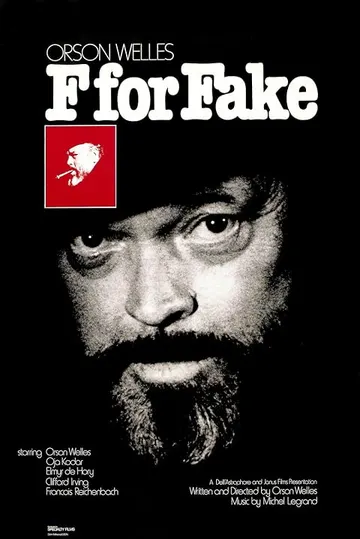
Orson Welles / 奥逊·威尔斯 · completed 1973 / released 1975
F for Fake
F for Fake
Each expert, forger, director, and narrator passes the tribunal to another. The question becomes whose power can create.
Film details
- Original title
- F for Fake
- Director
- Orson Welles / 奥逊·威尔斯
- Year
- completed 1973 / released 1975
- Region
- France / Iran / West Germany
Film analysis: how shots organize concepts
Editing lets forger, expert, market, and director take turns holding authority, until even the position that exposes deception enters the series of falsifiers.
- 01The director signs a temporal contract
With magic tricks, editing table, and direct address, Welles promises that the next hour will be true.
Truth is not an external standard; it is established as a speech act the filmmaker can manipulate. - 02Authority keeps changing hands
Elmyr's paintings, Irving's biography, expert certificates, museums, and the art market authenticate and undo one another.
Original and fake can no longer be separated by a final tribunal; the judge becomes another figure in the series. - 03Exposure keeps producing truth-effects
Welles admits that the Oja-Picasso story is invented, yet it has already organized looking, desire, and authorship.
The false no longer merely conceals fact; it shows how narration produces truths that circulate.
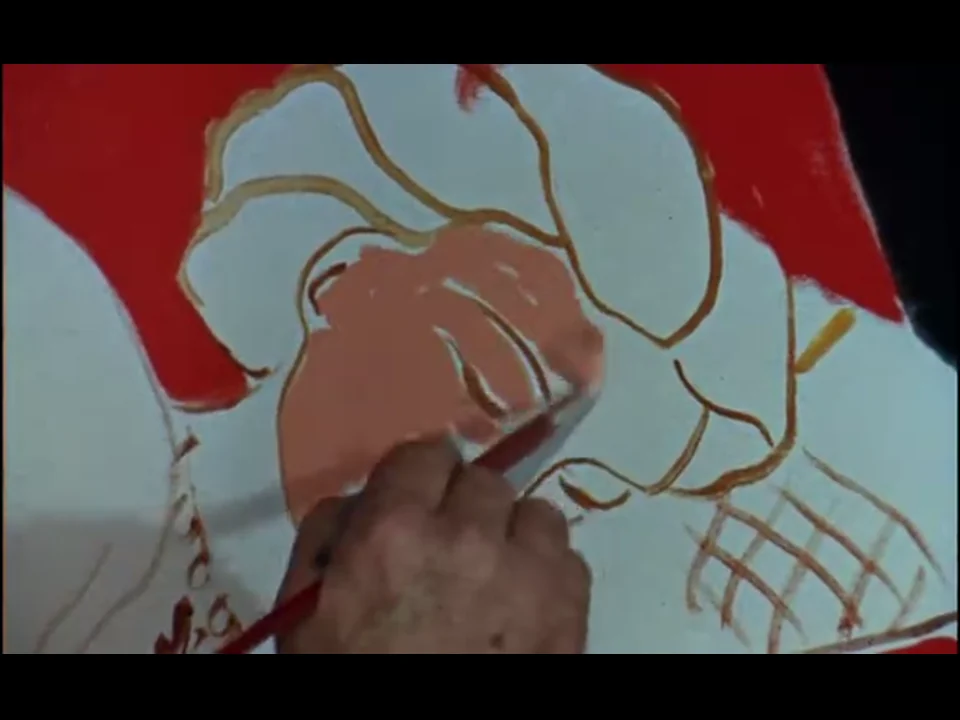 00:25:30
The act of imitation does not finish the authentication chain. Experts, museums, and dealers determine under whose name the image circulates.
Close shots follow hand and brush tracing lines, then cut among Elmyr, reproductions, and the studio.
The passage places fabrication, the artist's face, and publishable reproductions in the same chain.
Elmyr says that to resemble Matisse he must deliberately make his line appear hesitant.
He then challenges experts, museum directors, and dealers to distinguish the works.
SITE ANALYSISAuthenticity is no longer settled inside the image. The painter imitates style, experts assign names, institutions price the object, and Welles's editing rewrites every authority; authentication keeps moving through the series.
Cinema 2, chapter 6, English translation p. 150; atlas shot analysis.Bilibili at 00:25:30 Open original still ↗Bilibili single-part media timeline, frame-verified to within one second.Complete single-part film; title, year, 1:28:46 runtime, and anonymous playback were verified. Bilibili submission label: repost.
Bilibili full-film upload · 发呆的海绵宝宝 · verified 2026-08-14Analysis and scene sources
Shots and scenes
Primary texts, scholarship, and locators
Theory coordinate: Cinema 2, ch. 6, pp. 145–146
- 01Cinema 2: The Time-Image
Authoritative source for the standard translation, translators, ISBN, and publication date.
Open the atlas source record →
This film in books and research
《后人类影像:探索一种后德勒兹的电影哲学》 · Atlas extension
F for Fake
Film relation: SITE EXTENSION: uses editorial promises, performed authorship, and truth/falsehood reversals to test authenticity in generative-image culture.
Shot question: When is deception merely manipulative, and when does it reveal how regimes of truth are made?
Gilles Deleuze : cinéma et philosophie · Atlas analysis
F for Fake
Marrati pp. 86–101 · site test
Film relation: This site tests the film's chain of authentication through Marrati's direct time and crisis of truth. It does not equate true/false with actual/virtual, but follows authority as it migrates among author, forger, expert, editor, and spectator.
Shot question: When does the promise that everything for one hour is true cease to hold? How does the Picasso story continue producing effects of truth without a final authenticator?
Conclusion: The powers of the false do not hide truth more deeply; they put speaking positions and rules of judgment themselves into variation.
Gilles Deleuze’s Time Machine
F for Fake
Reading relation: Verify the argument through shifting authority among author, expert, and forger.
Powers of the False: How Falsifying Narration Creates Truth
Falsifiers form a series of powers
Claim: Expert, witness, forger, author, and camera alternately acquire and lose authority.
Conclusion: Mark the proposer, authenticator, and next version at each relay. When the authenticator is rewritten, the tribunal has entered the chain.
Cinema 2: The Time-Image · pp. 145–146Cinema, Truth and Time: The Falsifier · 22 November 1983 English transcript, p. 15Deleuze on Cinema · pp. 147–163
Powers of the False: How Falsifying Narration Creates Truth
Authentication keeps moving
Film comparison: Forger, biographer, market, and filmmaker alternately authenticate and undo one another.
Viewing gateways and editions
- Verified complete Bilibili carrier: 赝品 F for Fake 1973bilibili.comOpen film page ↗
- Page access
- Accessible when checked
- Version extent
- Recorded as a complete version
- Source type
- User-uploaded page
Edition note: Complete single-part film · 1:28:46; still-led analysis follows the relationship between the forger and expert authentication.
Link checked: 2026-08-14
- Criterion Collectioncriterion.comOpen film page ↗
- Source type
- Distributor or streaming platform