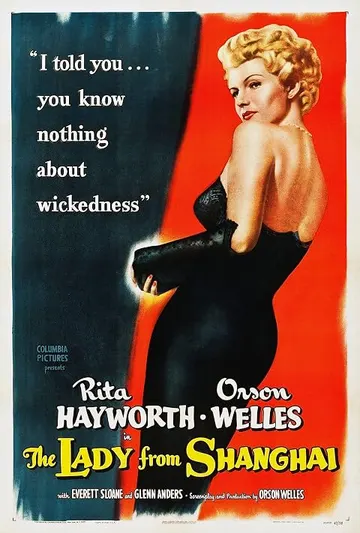
Orson Welles / 奥逊·威尔斯 · 1947
The Lady from Shanghai
The Lady from Shanghai
In the hall of mirrors, bodies, doubles, deception, and destruction reflect one another, dissolving stable ontological priority and forming a crystal.
Film details
- Original title
- The Lady from Shanghai
- Director
- Orson Welles / 奥逊·威尔斯
- Year
- 1947
- Region
- United States
Film analysis: how shots organize concepts
Deception first makes identities exchange within narration; the funhouse and mirror maze then turn that unreliable relation into a visible circuit of copies until gunfire cracks the crystal.
- 01Each figure supplies a version
Once Michael boards Bannister's yacht, Elsa, Grisby, and Bannister each advance accounts of love, faked death, murder, and legal escape.
Action proceeds through narratives that keep changing hands, drawing any stable tribunal of fact into the deceptive relation. - 02The funhouse spatializes versions
Michael crosses funhouse sets that rotate, tilt, and distort bodily scale; shadows, false passages, and grotesque surfaces block a straight escape.
Narrative unreliability becomes spatial unreliability as bodies and doubles lose stable coordinates. - 03Shattered mirrors terminate exchange
The hall of mirrors multiplies Elsa, Bannister, and their guns into rows of images; they fire at reflections, cracks spread, and only after mirrors fall do wounded bodies re-emerge.
Actual body and mirror-image become briefly indiscernible; gunfire does not expose one illusion but destroys the circuit sustaining their exchange.
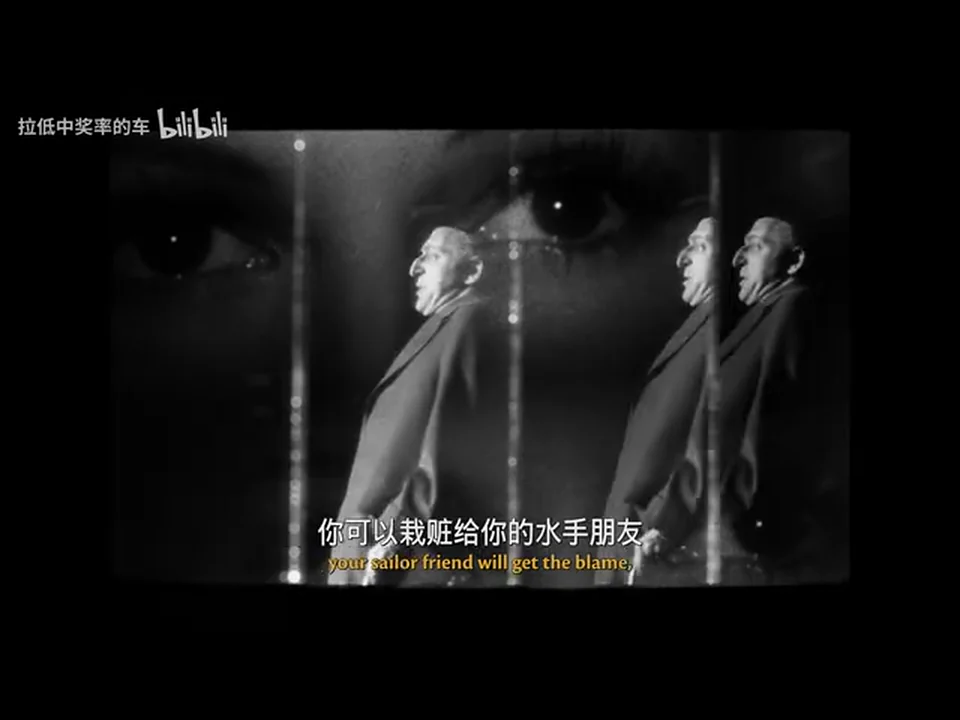 01:23:40
One speaker becomes body, reflection, and watched double at the same time.
Three profiles of Bannister stand side by side while mirror seams split them apart.
Enlarged eyes in the background share a plane with the foreground reflections, removing any stable position of vision.
Bannister continues shifting blame toward O'Hara; one voice corresponds to several visible bodies.
SITE ANALYSISActual body and virtual reflections remain distinguishable while continually exchanging within the hall; the later shattering is not decoration but the termination of this crystal circuit.
Cinema 2, chapter 4, pp. 68–87.Bilibili at 01:23:40 Open original still ↗The mirror-hall passage was frame-checked; the anchor precedes the gunfire that terminates the proliferating reflections.Complete Bilibili carrier; the shot at 单片 01:23:40 was checked frame by frame, and the still and timestamp come from the same public upload.
Bilibili · The Lady from Shanghai complete film · verified 2026-08-14Close-reading questions
- 01How does the hall of mirrors repeatedly disable distinctions among body, reflection, and target?
- 02When does shattered glass end actual–virtual exchange and return a space in which action can proceed?
Analysis and scene sources
Shots and scenes
Primary texts, scholarship, and locators
Theory coordinate: Cinema 2, ch. 4, p. 70
- 01Cinema 2: The Time-Image
Authoritative source for the standard translation, translators, ISBN, and publication date.
Open the atlas source record →
This film in books and research
Gilles Deleuze : cinéma et philosophie · Scholarly reading
The Lady from Shanghai
Marrati pp. 95–96
Film relation: Marrati uses the mirror maze to show actual and virtual entering the smallest circuit: bodies are absorbed by reflections, reflections acquire visible actuality, and gunfire finally shatters the apparatus of exchange.
Shot question: Mark bodies, reflections, doubles, and gunshots in sequence: which transition makes the two sides unassignable, and which act ends their exchange?
Conclusion: A mirror enters the crystalline relation only when it performs actual-virtual exchange; spatial duplication alone is insufficient.
The Crystal-Image: How Actual and Virtual Exchange
The smallest circuit preserves difference and removes fixed assignability
Claim: The crystal requires both actual–virtual difference in kind and unassignability within the circuit.
Conclusion: Identify the actual side, virtual side, and shot of exchange. The smallest circuit is established when all three are present.
Cinema 2: The Time-Image · p. 70Deleuze on Cinema · pp. 119–133
The Crystal-Image: How Actual and Virtual Exchange
Crystalline states determine how the circuit continues
Claim: Shattering, enclosure, turning, and decomposition are formal states of the circuit that determine temporal direction, not mood labels.
Conclusion: Record how the circuit terminates, shatters, grows, turns, or decomposes; the change of state gives its temporal direction.
The Crystal-Image: How Actual and Virtual Exchange
Shattered crystal
Film comparison: The hall multiplies actual and virtual; shattered mirrors terminate the circuit.
Time-image research chapters
How the crystal exchanges actual and virtual within one circuit
Bearing Time Chinese DOCX, paragraphs 134–273.
Claim: The crystal-image keeps actual and virtual distinct while making them exchange places in a minimal circuit.
What to watch for: Find the actual face, the virtual face, and the mechanism of exchange; then ask which becomes limpid and which recedes into opacity.
Viewing gateways and editions
- Verified complete Bilibili carrier: 上海小姐 The Lady from Shanghai (1947)bilibili.comOpen film page ↗
- Page access
- Accessible when checked
- Version extent
- Recorded as a complete version
- Source type
- User-uploaded page
Edition note: Complete single-part film · 1:27:31.
Link checked: 2026-08-13