Concept definition
As one face of the crystal becomes a clear actual image, the other recedes into opaque virtuality; then the two exchange. Their relation produces visibility.
What the concept explains
Limpid and opaque are not lighting styles but changing functions of the crystal's two faces: as one becomes a discernible actual image, the other recedes into virtual opacity, before the relation reverses. Analysis must establish the crystal first and then locate the exchange.
The Crystal-Image: How Actual and Virtual ExchangeFilms and scenes
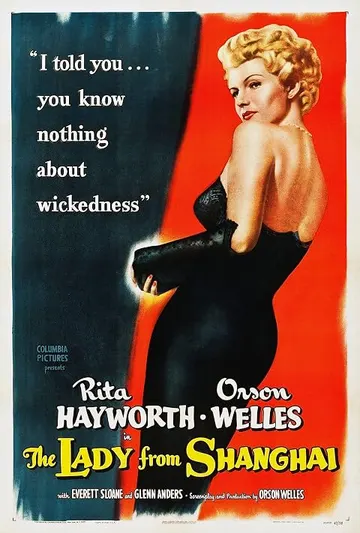
Body and reflection alternate as target and opaque double, tying limpid-opaque functions to crystalline exchange rather than lighting.
IMDb identification poster ↗Related film readings · 12 films
The Lady from Shanghai · 1947 · Candidate reading — Body and reflection alternate as target and opaque double, tying limpid-opaque functions to crystalline exchange rather than lighting.
Stalker · 1979 — The Zone refuses to become a transparent environment, returning the milieu to indeterminate opacity and the seed to the morbidity of something aborting. Rain and wet matter stage a hesitant search between material and spiritual.
Self Made · 2010 — Documentary performance training and fictional roles alternate between clarity and opacity; identity shifts continuously through performance.
Readings in the same thematic group
Late Spring · 1949 — The vase still life intervenes between the daughter’s smile and tears, placing change within time’s unchanging form.
8½ · 1963 — Reality, memory, fantasy, rehearsal, and the film project crystallize together; the unfinished work is both seed and environment absorbing life.
Lola Montès · 1955 — The circus present rolls a series of virtual pasts inside itself. Flashback becomes a route through the crystal; actual/virtual exchange is the criterion.
Mirror · 1974 — Deleuze explicitly calls it a turning crystal: mother and wife, childhood and present, memory and perception exchange actual and virtual positions.
Solaris · 1972 — Memory acquires an actual body on Solaris, forming a circuit with the virtual past. Evidence: a brief adjacent example in Cinema 2.
Journey to Italy · 1954 — Katherine is struck by unfolding landscapes and visual clichés, discovering something beyond what she can personally bear. She no longer resolves what she sees through action but becomes a seer.
Synecdoche, New York · 2008 — Caden copies New York inside a warehouse and assigns actors to copy friends, strangers, and himself. Each double demands more rooms, rehearsals, and doubles of doubles. The stage no longer abbreviates life; it expands like a crystalline seed into an environment that reabsorbs marriage, ageing, and death. Sammy first makes a profession of watching Caden and later assumes his role, showing that a copy is not a static image: it changes how the original can next live until neither person nor set retains an outside to which it can return.
Enter the Void · 2009 — City, memory, body, and possible futures interweave; viewing proceeds by reading relations among image strata.
Mulholland Drive · 2001 — Identity, performance, and memory rewrite one another. Criterion: an actual/virtual circuit.
Criteria
Which face is momentarily clear, how does it darken the other, and where do they reverse?
Distinctions and counterexamples
Light-dark contrast, transparency and concealment, or narrative clarity and mystery is insufficient. Without a reversal in actual-virtual attribution, the contrast remains visual or interpretive only.
Common confusion: Criterion: limpid and opaque exchange with the actual and virtual.
Texts and sources
Cinema 2, ch. 4; Deamer, 2016
- 01Deleuze’s Cinema Books: Three Introductions to the Taxonomy of Images
Detailed reconstruction with a film index; the nine-cell grid and eleven film cases carry the evidence status of Deamer’s later interpretation.
View source and edition → - 02Cinema 2: The Time-Image
Authoritative source for the standard translation, translators, ISBN, and publication date.
View source and edition →
Research disagreements
Replacement or coexistence?
The time-image reverses the subordination of time to movement; both regimes persist and can shift locally within one film.
Taxonomy or generator?
Fixed labels invite mere example-hunting; an open taxonomy requires new concepts to transform existing relations and explain across cases.
How do we use Deleuze precisely?
Test four layers: sensory-motor relation, actual/virtual circuit, audio-visual connection, and regime of truth.
Where contemporary images push this concept
Counterexample against conceptual overreachCandidate reading · versioned passage review pending
Coma: how do bedroom, livestream, and dolls compete for the place of reality?
Live action appearing clear while animation or the doll world appears obscure is a stylistic and epistemic contrast, not an exchange of limpid and opaque crystalline faces. The case is first a counterexample: the terms apply only if the same actual and virtual faces alternately clarify, darken, and exchange positions.
Scope and limits If limpid and opaque merely label live action and animation without specifying how they exchange intelligibility, the relation is a visual metaphor and should be removed from the concept graph.
- New York Film Festival: Coma film pageFestival institutional page · film factsThe institutional synopsis establishes media configuration, not a crystal structure or a time-image by itself.
- Pisters: The Neuro-Image guide and author pageScholarly monograph · author page and local PDFAuthor description and book synopsis are not independent film facts; concept pages must be checked against the published edition.
Counterexample against conceptual overreachCandidate reading · versioned passage review pending
Flee: how can animation conceal identity while carrying testimony?
Clear interview voice and opaque animated identity first describe testimonial ethics and media division, not the limpid and opaque faces of a crystal. The countertest requires the faces to reverse as actual and virtual exchange; anonymity or semantic clarity versus concealment is insufficient.
Scope and limits If voice and animation correspond illustratively one to one, and opacity comes only from identity protection without changing temporal or authenticating structures, documentary ethics is the sufficient description and crystal terminology should be withheld.
- Flee: Sounds of Fright and FlightPeer-reviewed article · animation, sound, and anonymityThe article is an animated-documentary bridge, not a substitute for Amin’s consent trail or edition-level checking of every animated passage.
- Pisters: The Neuro-Image guide and author pageScholarly monograph · author page and local PDFAuthor description and book synopsis are not independent film facts; concept pages must be checked against the published edition.
Concepts to distinguish
Compare them
- Actual / virtualactuel / virtuel
The actual is a formed and locatable state. The virtual consists of fully determined and fully real differential relations, singularities, memories, and tendencies. It is not a possible future or a blurred copy of the actual. The virtual is actualized through differenciation: actualization creates a solution rather than making a pre-existing model resemble reality, and the formed actual continues to carry the virtual problem to which it responds.
→ - Crystal-imageimage-cristal / hyalosigne
A crystal-image forms when an actual image and its own virtual image coalesce in the smallest internal circuit. The two faces pursue, feed back into, and exchange with one another. They preserve their difference in kind, yet the stable assignment of one face permanently to the actual and the other permanently to the virtual becomes undecidable. This objective indiscernibility makes visible the present's continual split into an actual present and a coexisting virtual past.
→ - Seed and environmentgerme et milieu
A seed triggers crystallization within an as-yet amorphous environment, while that environment must itself possess a virtual crystalline structure. Seed and milieu reciprocally individuate one another, making the crystal a world in formation.
→