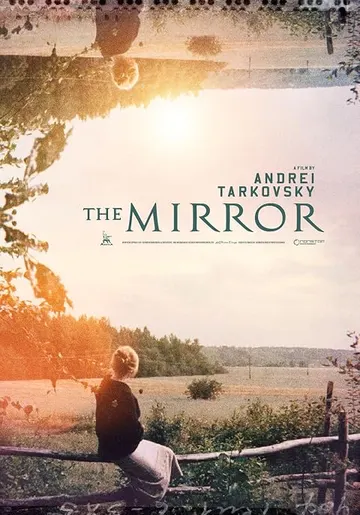
Andrei Tarkovsky / 安德烈·塔可夫斯基 · 1974
Mirror
Зеркало
Deleuze explicitly calls it a turning crystal: mother and wife, childhood and present, memory and perception exchange actual and virtual positions.
Film details
- Original title
- Зеркало
- Director
- Andrei Tarkovsky / 安德烈·塔可夫斯基
- Year
- 1974
- Region
- Soviet Union
Film analysis: how shots organize concepts
The same face, house, and material elements keep changing places between childhood and present, making memory not an inserted return to the past but a crystal that turns reality from within.
- 01Matter first connects times
Wind presses across the childhood field, doors and windows stir, and mother and children stand watching a barn burn; fire, water, smoke, and wooden walls persist beyond their actions.
The past first appears as a material milieu still at work, not as a private recollection explained by the adult. - 02One face exchanges generational positions
The same actor is both Maria, the mother in childhood, and Natalia, the former wife in the present; mirrors, doorways, and turns join the identities through similar gestures.
Resemblance no longer confirms one person but makes actual present and virtual past exchange which side is clear. - 03Ages coexist in one field
At the end the aged mother walks through the field beside the narrator's childhood children, while the younger mother occupies another temporal position in the same countryside.
Temporal sheets no longer obey the recollective order of one present; figures, ages, and place compose a turning crystal.
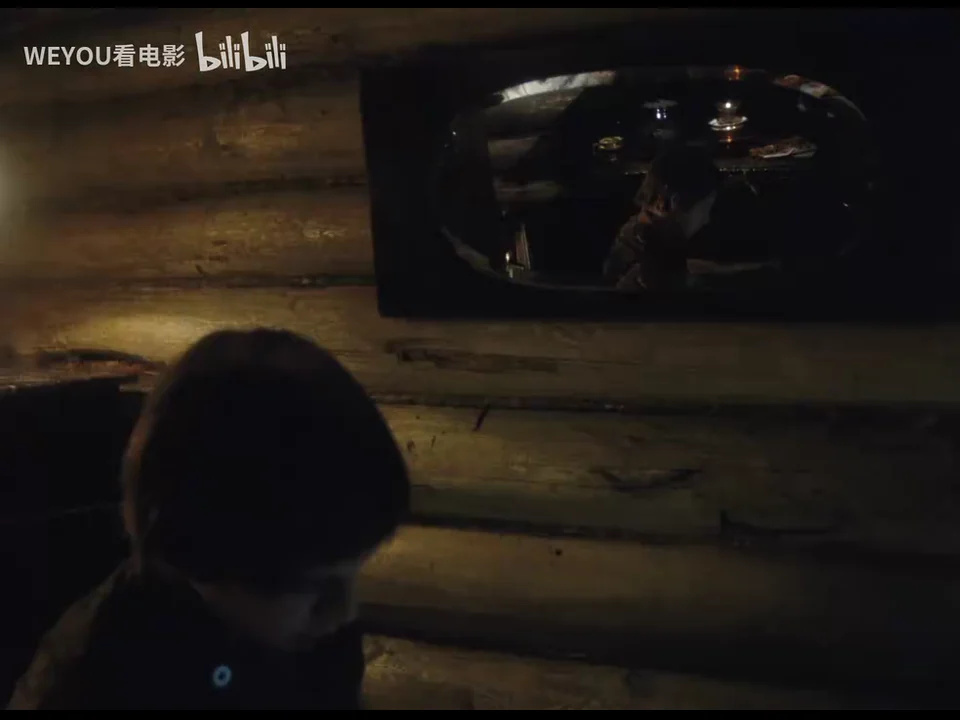 01:25:00
The boy outside the mirror and the reflected figures share one composition without reducing to one viewing position.
The boy's head remains below and outside the mirror; the oval glass inserts another group into the same timber-wall composition.
The bright mirror interior and darker exterior remain visible together without a cut to a separate memory shot.
Inside and outside the mirror share one continuous interior sound field; the reflected image receives no separate source of sound.
SITE ANALYSISThis mirror shot establishes only two visible zones within one composition; it does not by itself prove actual–virtual exchange. A crystalline reading still requires the returns of mother/wife, shifts between childhood and adulthood, and the archival passages.
Cinema 2, chapter 4, pp. 68–87.Bilibili at 01:25:00 Open original still ↗Frame-checked within the interior mirror passage.Complete Bilibili carrier; the shot at 单片 01:25:00 was checked frame by frame, and the still and timestamp come from the same public upload.
Bilibili · Mirror complete film · verified 2026-08-14Close-reading questions
- 01When mother and wife are played by one actor, how does resemblance become actual–virtual exchange between present and past?
- 02How do rain, water, fire, wind, and walls make memory more than personal recollection and turn it into the film's rotating crystalline environment?
Analysis and scene sources
Shots and scenes
Primary texts, scholarship, and locators
Theory coordinate: Cinema 2, ch. 4, p. 75
- 01Cinema 2: The Time-Image
Authoritative source for the standard translation, translators, ISBN, and publication date.
Open the atlas source record →
This film in books and research
Photography, Cinema, Memory · Atlas extension
Mirror
Film relation: Family photographs, news material, and poetic memory test an open crystalline circuit.
Shot question: How do archival material and private memory alter one another?
《缠绕的诗学:德勒兹思维方法研究》 · Atlas extension
Mirror
Film relation: Site extension: a mirror compresses a present body and another temporal position into one frame, testing whether actual and virtual exchange reciprocally.
Shot question: How do mirrored figures, the boy outside the glass, age, and memory-position turn together rather than merely symbolize reflection?
《后人类影像:探索一种后德勒兹的电影哲学》 · Atlas extension
Mirror
Film relation: SITE EXTENSION: tests whether untimely family, archive, and dream images make an unpaid spectral demand.
Shot question: When history enters private memory, which side rewrites the other?
Gilles Deleuze : cinéma et philosophie · Atlas analysis
Mirror
Marrati pp. 96–101 · site test
Film relation: Marrati points toward Tarkovsky at the end of the unit; this site further tests how mother/wife, childhood/adulthood, and news archive/family memory let a present coexist with its own virtual past.
Shot question: Do not begin by asking which passage is a memory. Ask how each return of face, house, and soundtrack rewrites the actuality of the present shot.
Conclusion: The crystal presents the ongoing act by which time splits, not a collection of memories that can be restored to chronological order.
Photography, Cinema, Memory
Mirror
Reading relation: Test open temporality through family images, historical material, and memory layers.
The Crystal-Image: How Actual and Virtual Exchange
The crystal shows time splitting at every instant
Claim: The present must pass while becoming present and preserve itself as past.
Conclusion: The crystal presents time's self-differentiation: how a present passes and is preserved, not the content of a recollection.
Cinema 2: The Time-Image · p. 75Gilles Deleuze: Cinema and Philosophy · pp. 70–73Cinema 2: The Time-Image · pp. 83–84
The Crystal-Image: How Actual and Virtual Exchange
Crystalline states determine how the circuit continues
Claim: Shattering, enclosure, turning, and decomposition are formal states of the circuit that determine temporal direction, not mood labels.
Conclusion: Record how the circuit terminates, shatters, grows, turns, or decomposes; the change of state gives its temporal direction.
The Crystal-Image: How Actual and Virtual Exchange
Turning crystal
Film comparison: Figures, ages, and memory positions exchange as the crystal turns from within.
Time-image research chapters
How the crystal exchanges actual and virtual within one circuit
Bearing Time Chinese DOCX, paragraphs 134–273.
Claim: The crystal-image keeps actual and virtual distinct while making them exchange places in a minimal circuit.
What to watch for: Find the actual face, the virtual face, and the mechanism of exchange; then ask which becomes limpid and which recedes into opacity.
Time-image research chapters
When heterogeneous times rewrite one another rather than merely coexist on screen
Bearing Time Chinese DOCX, paragraphs 1088–1160.
Claim: The final chapter turns the time-image into a testable relation: at least two heterogeneous times rewrite one another, shot, sound, editing, or apparatus carries the change, and a replayable consequence remains.
What to watch for: Find the exchange first, then its consequence; if times are merely displayed side by side, the work remains at the level of subject matter.
Time-image research dossier · English report core sample; primary atlas gateway
Mirror
Image operation: Mother and wife, childhood and present, private memory and war archive exchange places in a turning crystal.
Film question: Can the present still treat memory as its own background information?
Viewing gateways and editions
- Verified complete Bilibili carrier: 安德烈·塔可夫斯基高分电影【镜子 (1975)】中文字幕bilibili.comOpen film page ↗
- Page access
- Accessible when checked
- Version extent
- Recorded as a complete version
- Source type
- User-uploaded page
Edition note: Chinese subtitles · complete single-part film · 1:47:55.
Link checked: 2026-08-13
- Mosfilm official filmmosfilm.ruOpen film page ↗
- Source type
- Official source