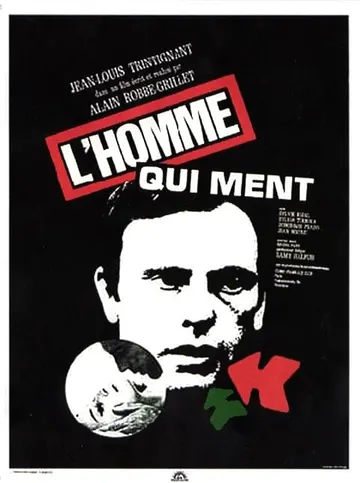
Alain Robbe-Grillet / 阿兰·罗布-格里耶 · 1968
The Man Who Lies
L’Homme qui ment
Each telling transforms narrator, characters, and world. Falsification becomes a power of becoming.
Film details
- Original title
- L’Homme qui ment
- Director
- Alain Robbe-Grillet / 阿兰·罗布-格里耶
- Year
- 1968
- Region
- France / Czechoslovakia
Film analysis: how shots organize concepts
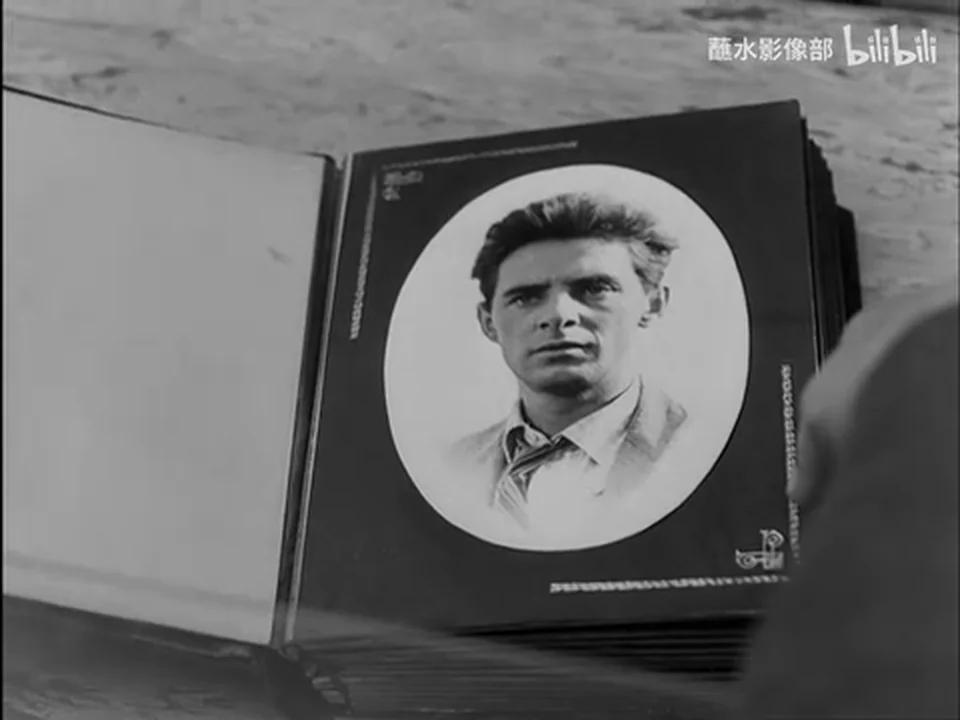 00:00:55
The face first appears as a dossier photograph, then as a moving body, then as another printed portrait; montage repeatedly reassigns identity.
An open dossier shows a frontal portrait, followed by a moving close-up of the same actor and another tilted printed portrait.
The audio is very low in this window and the upload has no platform subtitle track; the claim rests on the visible alternation, not dialogue.
SITE ANALYSISThe dossier does not stabilize the figure; it becomes one version in the figure's ongoing transformation. No final center authenticates photograph, body, and the next photograph.
Cinema 2, chapter 6, English translation pp. 131–133; atlas formal analysis of this edited window.Bilibili at 00:00:55 Open original still ↗Edited-upload timeline, frame-verified to within one second.A 4:18 edit of original-film images, not a continuous complete feature; film identity and anonymous playback were frame-verified, and the timecode refers only to this upload.
Bilibili edited original-film excerpt · 蘸水影像部 · verified 2026-08-14Analysis and scene sources
Shots and scenes
Primary texts, scholarship, and locators
Theory coordinate: Cinema 2, Minnesota 1989, ch. 5, p. 101; ch. 6, pp. 131–133; ch. 9, pp. 250, 260
- 01Cinema 2: The Time-Image
Authoritative source for the standard translation, translators, ISBN, and publication date.
Open the atlas source record →
This film in books and research
Powers of the False: How Falsifying Narration Creates Truth
Time places the model of truth in crisis
Claim: Undecidable pasts and inexplicable presents remove the external center that calibrates every version.
Conclusion: Record how each telling changes identity, past, and world-state; transformation must accumulate across versions.
Cinema 2: The Time-Image · pp. 131–133Deleuze on Cinema · pp. 147–163Cinema 2: The Time-Image · pp. 126–136Cinema, Truth and Time: The Falsifier · 12 June 1984 English transcript, pp. 22–23
Powers of the False: How Falsifying Narration Creates Truth
Identity changes with telling
Film comparison: Hero, traitor, witness, and impostor lack a fixed narrative center.
Viewing gateways and editions
No direct viewing link is listed; film search gateways are available above.