001
Scholarly research
Five Dedicated to Ozu
Five Dedicated to Ozu · 2003
Abbas Kiarostami / 阿巴斯·基亚罗斯塔米 · Iran
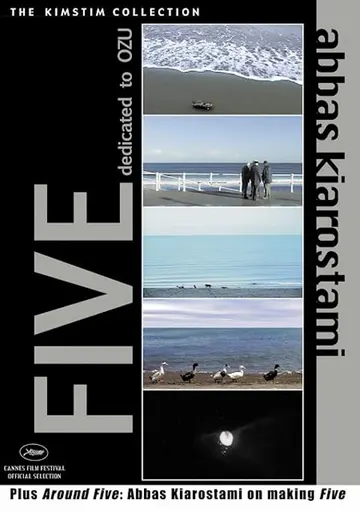
Human action leaves the centre; waves, driftwood, moonlight, frogs, and rain become temporal events that must be watched and heard.
An index of 147 films, with shot analysis, concept explanations, stills, scholarship, and viewing links. Search by title, director, concept, or viewing source, then open a film to read its analysis.
147 films; showing all 4 matches
Five Dedicated to Ozu · 2003
Abbas Kiarostami / 阿巴斯·基亚罗斯塔米 · Iran
Human action leaves the centre; waves, driftwood, moonlight, frogs, and rain become temporal events that must be watched and heard.

ลุงบุญมีระลึกชาติ · 2010
Apichatpong Weerasethakul / 阿彼察邦·韦拉斯哈古 · Thailand
The dead, the living, animals, and former lives unfold incompatible times on the same perceptual plane.
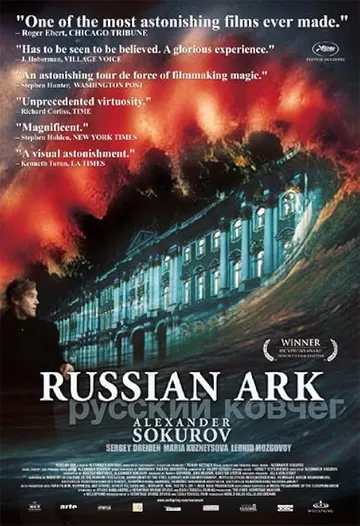
The single take turns the Hermitage into traversable sheets of the past, carrying history beyond a linear present.
Factory 420 is being demolished, so the place named by testimony disappears from the image while it is being narrated. Workers and performers including Joan Chen, Lü Liping, and Zhao Tao share the same frontal interview form. The film neither lets professional identity settle truth nor equates performance with deceit; dialect, pause, facial detail, old photographs, popular songs, and demolition dust test one another. Here the power of the false does not abolish history. It forces history to acknowledge that urban memory can only be produced among heterogeneous tellings.
64 scene analyses describe images, sounds, characters’ actions, and temporal relations. Bilibili viewing links accompany 16 of the films.
Each essay begins with continuous scenes and connects them to primary passages, seminar records, cited scholarship, and atlas analysis.
Ask whether it merely supplies causal information; time becomes the issue only when distinct sheets of past coexist without reducing to one recollection.
A mirror is only a formal clue; a crystal requires actual and virtual to exchange while remaining indiscernible.
Duration is not the conclusion; ask whether persistence, waiting, and intervals subordinate movement to time rather than merely slowing action.
Timecodes refer to the edition named in each entry. Primary-text locators distinguish Minnesota 1989 from Bloomsbury Revelations 2013; scene analyses and bibliography records have direct links. Research library
Title, year, and director distinguish films with the same name. Posters include their source; original title cards are labelled separately.
Search by title and year for film records, cast, and edition details.
Viewing links distinguish features from excerpts. Part numbers, film start times, subtitles, login requirements, and region restrictions appear beside the relevant link.
Deleuze directly uses the film to establish, distinguish, or deepen a concept.
The film appears in Cinema 2 as a brief example, list item, or supporting mention.
Established by a named monograph, article, or special issue.
Conceptual interpretations and comparisons developed from specific shots.
Filter the film directory by platform, edition, or viewing conditions.