FILM ATLAS

Film atlas

An index of 147 films, with shot analysis, concept explanations, stills, scholarship, and viewing links. Search by title, director, concept, or viewing source, then open a film to read its analysis.

Films and analyses

002
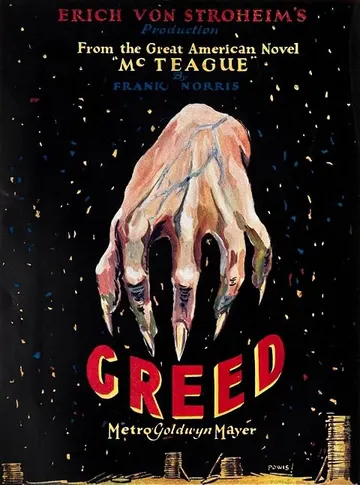
Greed identification poster
IMDb identification poster
Deleuze primary text

Greed

Greed · 1924

Erich von Stroheim / 埃里克·冯·施特罗海姆 · United States

impulse-imageoriginary worldentropy

Three passages are now located, while their theoretical relation remains a candidate reading constrained by counterevidence. From 02:51:30 to 02:57:31, the giant gold tooth sign is first proposed for sale as an exchange object; the old meat and demand for change that immediately follow still belong to ordinary exchange and a practical budget. The passage therefore first contests the claim that a golden object is automatically a fetish. From 03:02:06 to 03:02:42, Trina counts her savings, brings the money close to her face, and addresses it as second-person 'you': grasping and hoarding as real behaviours or gestures may be symptom candidates. Only when money is withdrawn from exchange and use into something solely kept and caressed does it approach a fetish candidate. From 03:50:45 to 03:55:39, the money bag, money, dead horse, broken canteen, handcuffs, and caged bird enter one exhausted desert milieu, but money, teeth, and the caged bird cannot be collapsed in advance into one class of object-fragments or fetishes: the canteen, handcuffs, and bird first belong to material relations of water loss, restraint, and exhausted life respectively. Page 125 generally defines the four structural terms and symptom or fetish while directly listing Greed's desert ending as a localized originary world. Page 128 directly names the film's impulse for gold, then defines partial object and fetish in general; pp. 126–130 also develop descent, entropy, and environmental exhaustion. Exact timecodes, the tooth's exchange function, the caress of money, and distinctions among the final objects remain the atlas's responsibility.

003
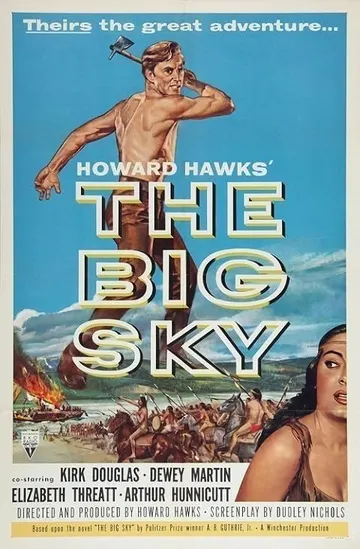
The Big Sky identification poster
IMDb identification poster
Deleuze primary text

The Big Sky

The Big Sky · 1952

Howard Hawks / 霍华德·霍克斯 · United States

encompasserHawksian functionalismmakeshift group

Sky first encompasses land, river, and expedition; the Missouri then stretches the static Western milieu into a long fluid route. Companions of different backgrounds do not fuse into a national community but connect through paddling, negotiation, guarding, and improvisation. The escape by a low branch in the rapids turns the gap between immense nature and small-group action into a locally usable function.

SCENES · 16 DOSSIERS

Film stills and scene analysis

64 scene analyses describe images, sounds, characters’ actions, and temporal relations. Bilibili viewing links accompany 16 of the films.

Open scene evidenceTake films into cross-readingOpen poster–still atlas
FILM ARGUMENTS · 3

Theory unfolds inside the shot

Each essay begins with continuous scenes and connects them to primary passages, seminar records, cited scholarship, and atlas analysis.

Brief mention by Deleuze · 1948Germany Year ZeroRuins, historical sound, sensory-motor rupture, and the child seerDeleuze primary text · 1963Pour la suite du mondeOral memory, the beluga hunt, fabulation, and a people to comeAtlas analysis · 2004Tropical MaladyRupture, soundscape, queer time, and becoming in Tropical Malady
01A flashback is not direct time

Ask whether it merely supplies causal information; time becomes the issue only when distinct sheets of past coexist without reducing to one recollection.

02A mirror is not automatically a crystal

A mirror is only a formal clue; a crystal requires actual and virtual to exchange while remaining indiscernible.

03A long take does not automatically present time

Duration is not the conclusion; ask whether persistence, waiting, and intervals subordinate movement to time rather than merely slowing action.

Edition, source-label, and viewing notes

Timecodes refer to the edition named in each entry. Primary-text locators distinguish Minnesota 1989 from Bloomsbury Revelations 2013; scene analyses and bibliography records have direct links. Research library

IDENTIFY · VERIFY · WATCH

Film identification and viewing

Poster / title card

Title, year, and director distinguish films with the same name. Posters include their source; original title cards are labelled separately.

Douban lookup

Search by title and year for film records, cast, and edition details.

Features and excerpts

Viewing links distinguish features from excerpts. Part numbers, film start times, subtitles, login requirements, and region restrictions appear beside the relevant link.

Deleuze primary text

Primary conceptual case

Deleuze directly uses the film to establish, distinguish, or deepen a concept.

Brief mention by Deleuze

Brief mention by Deleuze

The film appears in Cinema 2 as a brief example, list item, or supporting mention.

Scholarly research

Cited later scholarship

Established by a named monograph, article, or special issue.

Atlas analysis

Atlas analysis

Conceptual interpretations and comparisons developed from specific shots.

ONLINE FILM SOURCE RESEARCH

Find a viewing source

Filter the film directory by platform, edition, or viewing conditions.

Viewing links
155
Version
Features, excerpts, restorations, and altered cuts
Bilibili sources
108