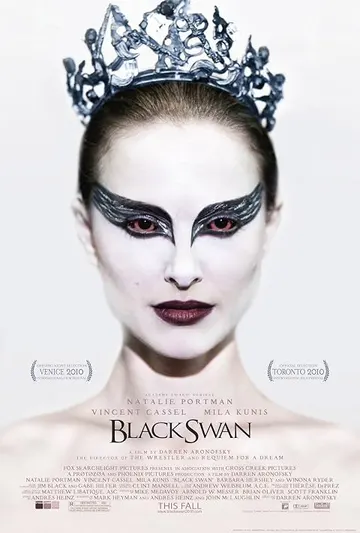
The rehearsal mirror first corrects Nina's body, then reflections hesitate, slip out of phase, and even move before she does. The mirror no longer confirms a whole self; it compresses Nina and Lily, White Swan and Black Swan, into one body. Scratches, feathers, toes, and stage transformation are therefore more than illustrations of subjective hallucination: actual and reflected bodies rewrite one another, filming 'becoming the role' as a circuit that produces the performer in return.
Film atlas
An index of 147 films, with shot analysis, concept explanations, stills, scholarship, and viewing links. Search by title, director, concept, or viewing source, then open a film to read its analysis.
147 films; showing all 2 matches
Films and analyses

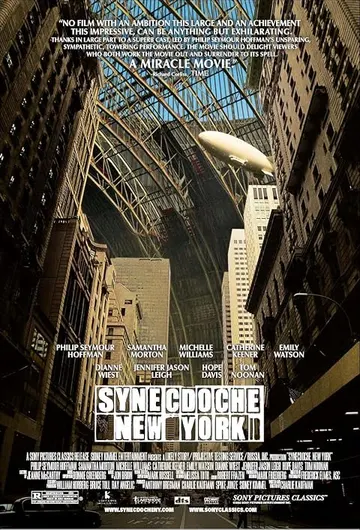
Synecdoche, New York
Synecdoche, New York · 2008
Charlie Kaufman / 查理·考夫曼 · United States
Caden copies New York inside a warehouse and assigns actors to copy friends, strangers, and himself. Each double demands more rooms, rehearsals, and doubles of doubles. The stage no longer abbreviates life; it expands like a crystalline seed into an environment that reabsorbs marriage, ageing, and death. Sammy first makes a profession of watching Caden and later assumes his role, showing that a copy is not a static image: it changes how the original can next live until neither person nor set retains an outside to which it can return.
Film stills and scene analysis
64 scene analyses describe images, sounds, characters’ actions, and temporal relations. Bilibili viewing links accompany 16 of the films.
Theory unfolds inside the shot
Each essay begins with continuous scenes and connects them to primary passages, seminar records, cited scholarship, and atlas analysis.
Ask whether it merely supplies causal information; time becomes the issue only when distinct sheets of past coexist without reducing to one recollection.
A mirror is only a formal clue; a crystal requires actual and virtual to exchange while remaining indiscernible.
Duration is not the conclusion; ask whether persistence, waiting, and intervals subordinate movement to time rather than merely slowing action.
Edition, source-label, and viewing notes
Timecodes refer to the edition named in each entry. Primary-text locators distinguish Minnesota 1989 from Bloomsbury Revelations 2013; scene analyses and bibliography records have direct links. Research library
Film identification and viewing
Title, year, and director distinguish films with the same name. Posters include their source; original title cards are labelled separately.
Search by title and year for film records, cast, and edition details.
Viewing links distinguish features from excerpts. Part numbers, film start times, subtitles, login requirements, and region restrictions appear beside the relevant link.
Primary conceptual case
Deleuze directly uses the film to establish, distinguish, or deepen a concept.
Brief mention by Deleuze
The film appears in Cinema 2 as a brief example, list item, or supporting mention.
Cited later scholarship
Established by a named monograph, article, or special issue.
Atlas analysis
Conceptual interpretations and comparisons developed from specific shots.
Find a viewing source
Filter the film directory by platform, edition, or viewing conditions.
- Viewing links
- 155
- Version
- Features, excerpts, restorations, and altered cuts
- Bilibili sources
- 108
